ZME–BNA Letter of Agreement
Responsibilities
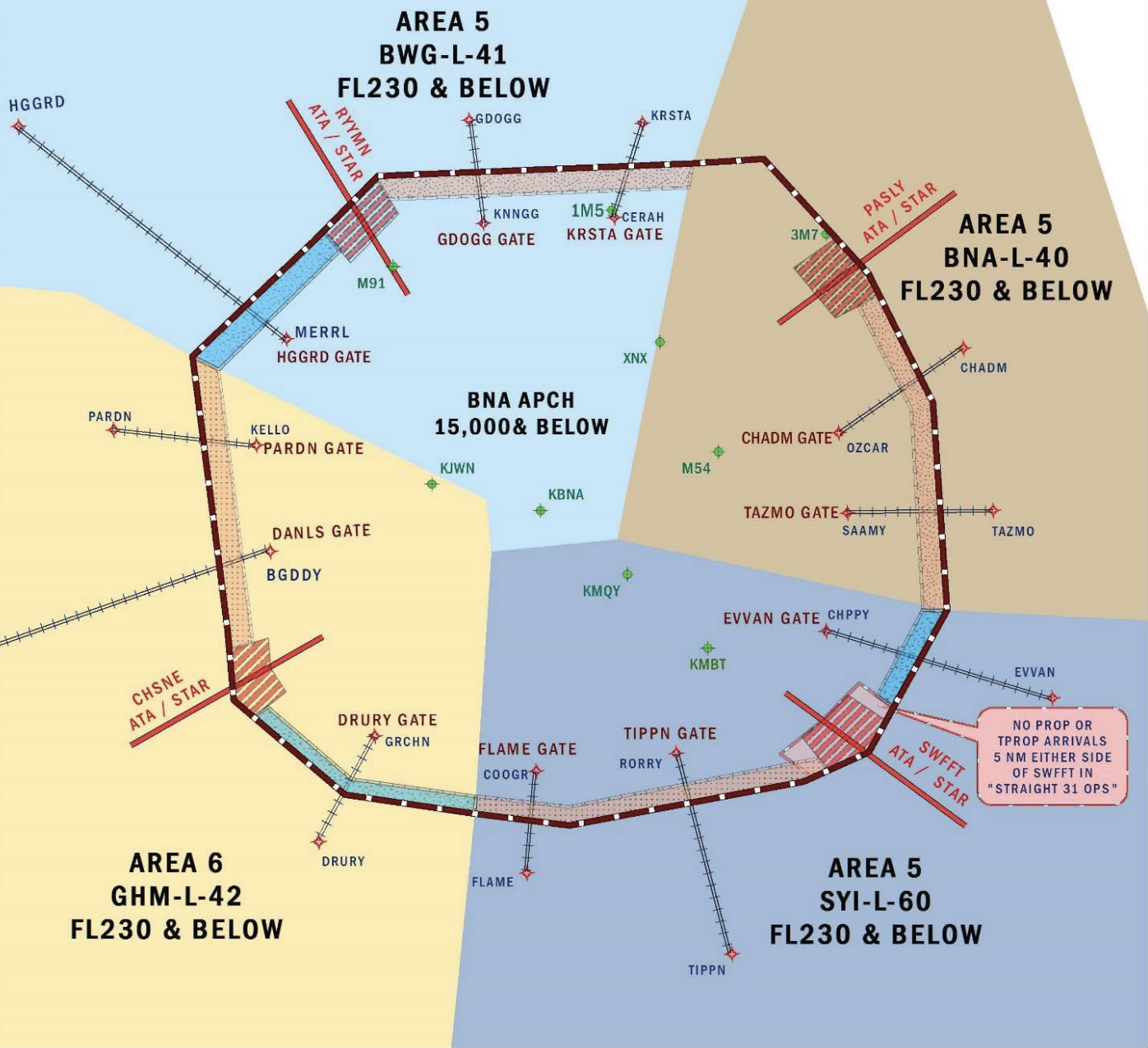
Section titled “Responsibilities”Memphis ARTCC (ZME) delegates to Nashville ATC Tower (ATCT) authority and responsibility for control of IFR aircraft operations within the terminal area depicted on Attachment 1. The ARTCC and ATCT shall transition arrivals and departures via the Arrival Transition Areas (ATA) and Departure Transition Areas (DTA) depicted on Attachment 1.
Arrivals
Section titled “Arrivals”KBNA Turbojet Arrivals
Section titled “KBNA Turbojet Arrivals”RNAV (OPD): All RNAV turbojet aircraft cleared via an RNAV STAR must enter TRACON airspace established and descending via the appropriate STAR, unless otherwise coordinated. BNA will have control on contact.
Conventional: All turbojets shall cross the ATA BNA 40 DME fix at 11,000 ft. Turbojets operating below 11,000 ft shall be verbally coordinated. BNA will have control on contact.
KBNA Turboprop Arrivals
Section titled “KBNA Turboprop Arrivals”Turboprops must be direct to BNA. BNA will have control on contact.
| From ZME Sector | Crossing Altitude at TCP |
|---|---|
| Sector 42 (GHM) | 7,000 ft |
| Sectors 40, 41, 60 | 8,000 ft |
KBNA Reciprocating Arrivals
Section titled “KBNA Reciprocating Arrivals”Reciprocating aircraft must be direct to BNA. BNA will have control on contact.
| From ZME Sector | Crossing Altitude at TCP |
|---|---|
| Sector 42 (GHM) | 5,000 ft |
| Sectors 40, 41, 60 | 6,000 ft |
”Straight 31 Operation”
Section titled “”Straight 31 Operation””When BNA advises a Straight 31 Operation, arrivals over SWFFT must be at the following altitudes:
| Aircraft Type | Qualification | Altitude |
|---|---|---|
| RNAV aircraft | — | Descend via STAR |
| Conventional turbojets | — | Cross SWFFT ATA BNA 40 DME fix at 8,000 ft |
| Turboprops | From ZME SYI sector — vectored ≥5 NM either side of HIMAT | Cross BNA 40 DME fix at 6,000 ft |
| Props | From ZME SYI sector — vectored ≥5 NM either side of HIMAT | Cross BNA 40 DME fix at 4,000 ft |
Satellite Airport Arrivals (3M7, 1M5, M91, XNX, M54, KMQY, KMBT, KJWN)
Section titled “Satellite Airport Arrivals (3M7, 1M5, M91, XNX, M54, KMQY, KMBT, KJWN)”| Aircraft Type | From ZME Sector | Routing | Crossing Altitude |
|---|---|---|---|
| Turbojet | Any | Via appropriate arrival fix → BNA VORTAC → destination, or appropriate STAR | Arrival transition fix at 11,000 ft |
| Turboprop | Sector 42 | Direct destination | TCP at 7,000 ft |
| Turboprop | Sectors 40, 41, 60 | Direct destination | TCP at 8,000 ft |
| Reciprocating | Sector 42 | Direct destination | TCP at 5,000 ft |
| Reciprocating | Sectors 40, 41, 60 | Direct destination | TCP at 6,000 ft |
BNA will have control on contact for all satellite arrivals.
Arrivals to KMRC, KGHM, M02, 4M7, KBWG, 0A3, KRNC, KSYI, KTHA, KLUG, KSRB
Section titled “Arrivals to KMRC, KGHM, M02, 4M7, KBWG, 0A3, KRNC, KSYI, KTHA, KLUG, KSRB”These aircraft must:
- Exit BNA airspace descending to 4,000 or 5,000 ft (appropriate for direction of flight).
- Be released to ZME for control on contact.
General
Section titled “General”- When BNA has control on contact of aircraft in ZME airspace (or vice versa), neither facility may reverse, hold, or climb an arrival until the aircraft is contained within its own delegated airspace.
- ATCT shall keep the ARTCC advised of the current runway configuration, arrival rates, and when holding is anticipated.
Departures
Section titled “Departures”- RNAV turbojets must be cleared via the appropriate RNAV SID.
- All other departures must be established on a vector heading within the appropriate DTA. The following pairs of DTAs are each treated as one DTA:
- DANLS / PARDN
- FLAME / TIPPN
- CHADM / TAZMO
- GDOGG / KRSTA
- Aircraft filed at or below 7,000 ft must be cleared on course.
- Tower must clear turbojet aircraft to maintain 15,000 ft or requested altitude (whichever is lower), and to expect requested altitude 5 minutes after departure.
- BNA must provide 5 NM separation (constant or increasing) between departures and/or enroute aircraft entering ZME airspace at the same altitude.
- BNA must release aircraft for turns of up to 20° at the BNA VORTAC 25 DME fix.
Overflights
Section titled “Overflights”Overflights shall be via routes/altitudes as filed.
- Calm wind runways: 20L, 20R, and 20C.
- Deviations from this agreement may only be made after coordination that completely defines responsibility.
Attachment 1 — Terminal Area Chart
Section titled “Attachment 1 — Terminal Area Chart”